After my recent revelation, I decided to make another one of these Dragnet/LSD mandalas. I figured that knowing what I was doing would help and that I could now make the work with a little more intention. I'm reasonably pleased with the outcome.
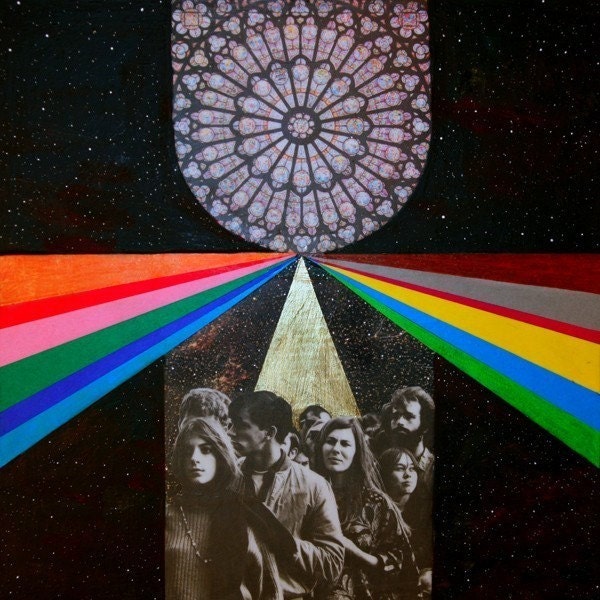
Pink Floyd provide a framework for a discussion of Brandi Strickland’s collage work. From her studio in Charlotte, NC, Strickland makes collages that bridge Hipgnosis designed album covers from the hazy, halcyon days of prog rock and a sixth grade social studies book from 1972. Her work has the exuberance of someone who has just the listened to The Dark Side of the Moon through headphones for the first time. This excitement is balanced by the ambiguity of the first inklings of metaphysics, and the apprehension of opening the mind to darker depths. Recognizing that such a balance exists, and describing it in so striking a manner, Strickland’s work is highly thoughtful indeed.
“Let There be More Light” is the title of an ominous, minor key number from Pink Floyd’s 1968 album A Saucerful of Secrets, and a conceit of Strickland’s work. In subsequent years Pink Floyd would hone their ability to mingle dirge-like chunks of fuzz and lilting, pastoral melodies.
"Zenith"
The lyrical content turned to themes of work and banality, offered in contrast to the prevalent themes of outer space and innerspace, astral voyage and astral projection. Such themes and contrasts are deftly blended in Strickland’s collages.
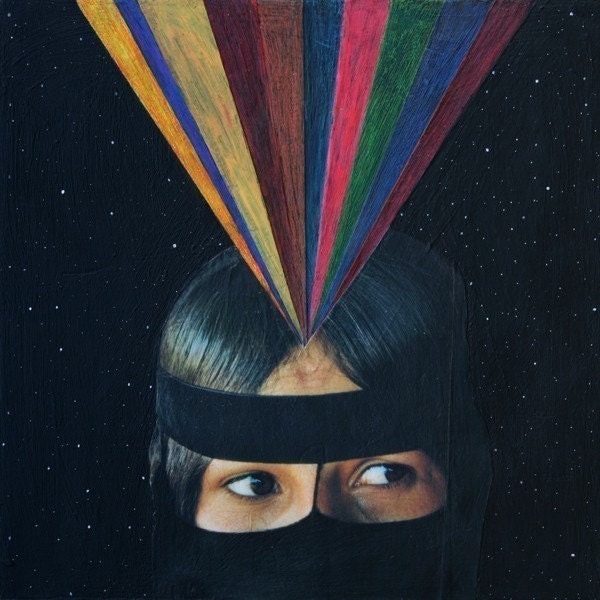
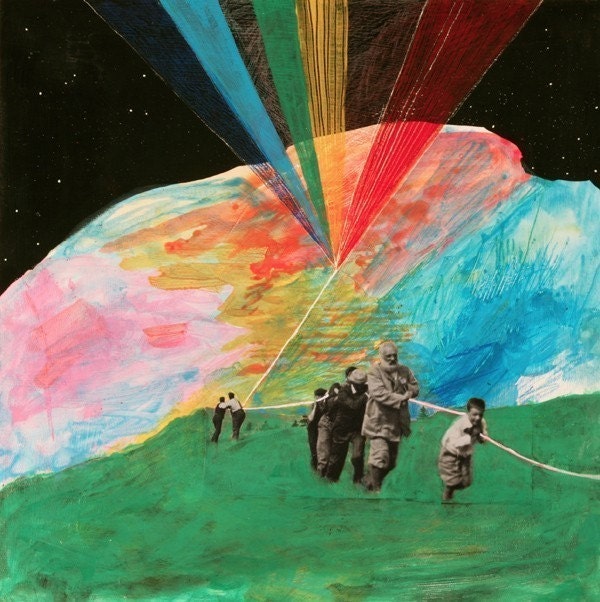
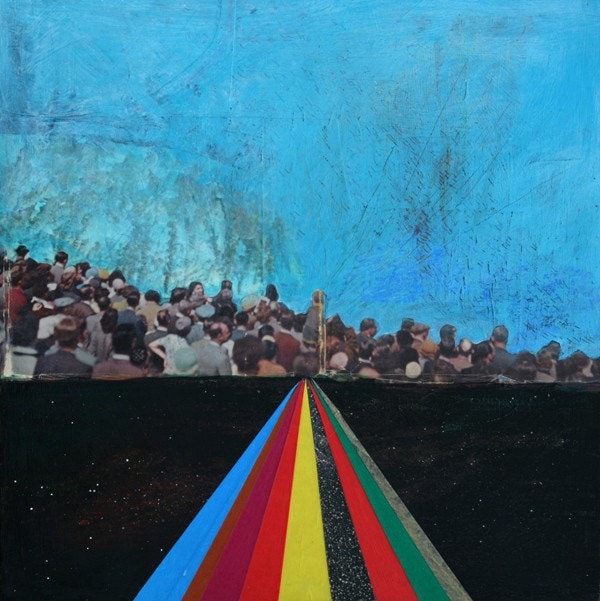
Strickland’s collages are immediately striking. Radiant beams cross broad areas of formless dark. Hard-edged shapes and color carve the picture plane into tectonic plate-like slabs. Visually, there is a dynamic interplay of powerful forms. Human subjects people the fields of these strong shapes. Alone or together, they make contact with prismatic beams of color that invariably spread out toward the edge of the image.
"Universe Kite"
Within a historical context determined by the work that Strickland’s most resembles, her collages depict the expanding consciousness as moments of balance, points where horror and reverie are the cost and benefit of searching for more meaning, more light. Her work reminds that this quest for illumination can be scientific as well as spiritual. Any type of search for meaning requires a degree of faithfulness to stories, rituals and traditions.
In Strickland’s collages, there are many visual allusions to The Eye of Providence, which has spiritual meaning, but also associations with control and authority. Depending on whom you ask, the eye in the triangle represents a benevolent God watching over all, or a nefarious secret society of Illuminati. In any regard the triangles radiating light from their pinnacles suggest illumination.
"When You’re Done Here, You Get to Go Home"
The illumination, or higher spiritual states in Strickland’s work are achieved through ritual and endeavor. There are neutral expressions on the faces of the subjects. They could be performing joyless penance, or possessed of a blissful state of non-attachment earned by meditation, or deep immersion in their work.
The palpable tension in Strickland’s collages come not just from the literal balance of dark and light but the assertion that transcendence can only be conceived of in terms of toil, struggle and a dogged faithfulness to an abstract. Such faithfulness is as likely to yield ecstatic communion with the divine as much as doubt, fear and isolation. Brandi Strickland’s collages depict the quest for illumination, harrowing and exhilarating by turns, with noble and thoughtful grace.
“ ‘C’est la vie,’ say the old folks, ‘it goes to show you never can tell.’ ” –Chuck Berry
On January 12, 1967, Jack Webb brought Dragnet blazing back to the small screen in a new incarnation, re-vamped for the times-- Dragnet 1967. The first episode was “The LSD Story,” and it is perhaps the most famous episode of Dragnet ever.
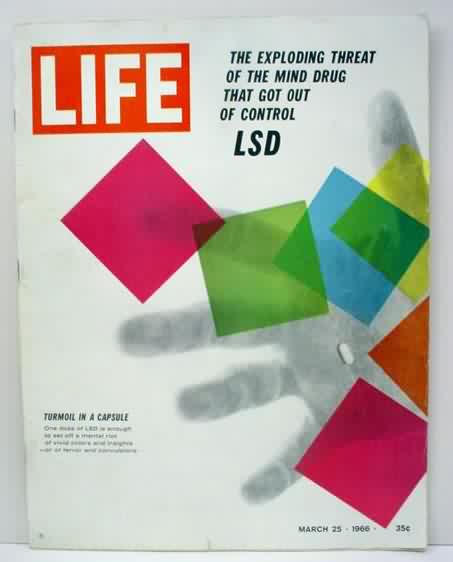
Dragnet 1967, and particularly “The LSD Story,” is part of the media acid panic of the late 1960’s. At once creating fear and mystique, there was much hysterical rhetoric around LSD. Driven into the black market, and thus the mainstream, when it was officially prohibited on the ominous date October 6, 1966, acid was hot on the cultural radar, titillating the teenagers and scaring their parents. The implications of this, and other fascinating acid conspiracies, are well examined in Martin A. Lee and Bruce Shlain’s book Acid Dreams.
“The LSD Story” was directed and written by Jack Webb himself (he was credited as John Randolph), and as in every Dragnet episode he portrayed Sgt. Joe Friday. Among some other pretty wild assertions in “The LSD Story” Joe Friday gives “the ghost, the beast, the chief and the hawk” as “acid freak” parlance for LSD.
The ghost, the beast, the chief, the hawk.
Those words, all having dark and/or authoritarian connotations, sound a minor key against the subject of LSD. They are a creepy counterpoint to the brightly colored and Baroque language typically associated with the acid experience. Ghost, beast, chief and hawk are effective poetic choices in this way, but they have a meaning beyond their formal aspect.
These terms have a corollary in ancient symbology as the angel (ghost), the lion (beast), the bull (chief) and the eagle (hawk). The angel, lion, bull and eagle are mentioned specifically in the Old Testament of the Bible. They are mentioned too in the book of Revelation, and they are associated with the four authors of the Gospels in the New Testament: Matthew-- the angel, Mark-- the lion, Luke-- the bull, John--the eagle.
The angel, lion, bull and eagle appear on the Tarot cards “The World” and “The Wheel”—they surround the world, and the wheel. A sphinx, such as the famous one in Giza, appears to be a morphological combination of these symbols.
The symbols are associated with the four elements (angel-water, lion-fire, bull-earth, eagle-air), and analogous to the Zodiac signs Libra, Leo, Taurus and Scorpio.
The angel, lion, bull, and eagle are used to symbolize four extreme personality types in Robert Anton Wilson’s behavior theory described in his book Prometheus Rising.
Basically, these extremely generalized personality types are created by an orientation toward one quadrant of a matrix generated by the programming of the first two neurological circuits of the mind. Circuit One operates bio-survival. An animal advances toward nurturing and safety or retreats from harm (forward and back). Circuit Two controls brain functioning on the inter-personal/political level. An animal enlarges its body to dominate, or shrinks in domination by another (up and down). A combination of that up-down, forward-back represent four very basic “directions” for a person to go when they are pulled off center, so to speak. People can be like an angry, domineering and paranoid hawk, a stubborn, truculent bull, an easy going, passive angel, a prideful, generous lion, or some combination thereof.
Again, these symbols encircle a complex subject, they lie outside of the center.
The terms ghost, beast, chief and hawk were chosen by Jack Webb to name LSD. Whether he read them somewhere, or he heard them when he infiltrated a gang of “acid freaks,” or he made them up because they sounded good is unknown, and unimportant. In “The LSD Story” they identify LSD, the terms encircle the idea of LSD.
In the past year and a half, I have occasionally made gouache works dealing with the ghost, the beast, the chief and the hawk. Always, I have made them the same way-- with the words in the four corners of radiating squares. It just felt natural to do so, and now I know why.
The Ghost, The Beast, The Chief, The Hawk, Gouache on Paper, 2009
The work is a mandala. The center from which the colorful squares radiate is blank and roughly the size of a tab of blotter acid. This representation of an acid tab, as an empty center, the silenced ego, describes a condition commonly attributed to an acid trip. The idea of LSD is framed by four terms with ancient symbolic analogs, which name, reduce and generalize their subject.
All of these connections and conclusions were drawn only after I was finishing this most recent version of this work. As Joseph Campbell’s work famously points out, ancient symbols pervade even contemporary culture. Evidently they remain potent enough to communicate directly with the subconscious.



 The ghost, the beast, the chief, the hawk.
 Those words, all having dark and/or authoritarian connotations, sound a minor key against the subject of LSD. They are a creepy counterpoint to the brightly colored and Baroque language typically associated with the acid experience. Ghost, beast, chief and hawk are effective poetic choices in this way, but they have a meaning beyond their formal aspect.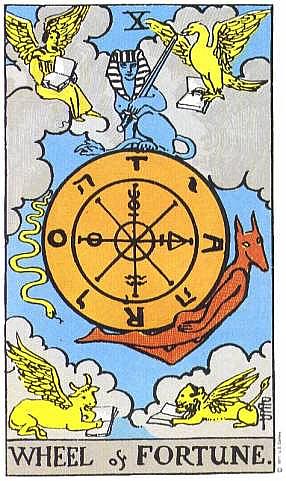
 A sphinx, such as the famous one in Giza, appears to be a morphological combination of these symbols.
 A combination of that up-down, forward-back represent four very basic “directions” for a person to go when they are pulled off center, so to speak. People can be like an angry, domineering and paranoid hawk, a stubborn, truculent bull, an easy going, passive angel, a prideful, generous lion, or some combination thereof.
  Whether he read them somewhere, or he heard them when he infiltrated a gang of “acid freaks,” or he made them up because they sounded good is unknown, and unimportant. In “The LSD Story” they identify LSD, the terms encircle the idea of LSD.
 The work is a mandala. The center from which the colorful squares radiate is blank and roughly the size of a tab of blotter acid. This representation of an acid tab, as an empty center, the silenced ego, describes a condition commonly attributed to an acid trip. The idea of LSD is framed by four terms with ancient symbolic analogs, which name, reduce and generalize their subject.